


Applied Structural Drying: 4 Proven Phases to Success
Beyond Fans and a Mop: Understanding the Science Behind True Water Damage Recovery
Applied structural drying is the effective, efficient process of removing excessive moisture from water-damaged buildings using specialized equipment, scientific principles, and trained techniques—without requiring extensive demolition. Here’s what you need to know:
What Applied Structural Drying Does:
- Removes moisture systematically using extraction, air movement, dehumidification, and temperature control
- Prevents secondary damage like mold growth, warping, and structural deterioration
- Saves materials that basic drying methods would require you to demolish and replace
- Accelerates recovery by using psychrometry (the science of drying) to create optimal conditions
Why It’s Different from Basic Drying:
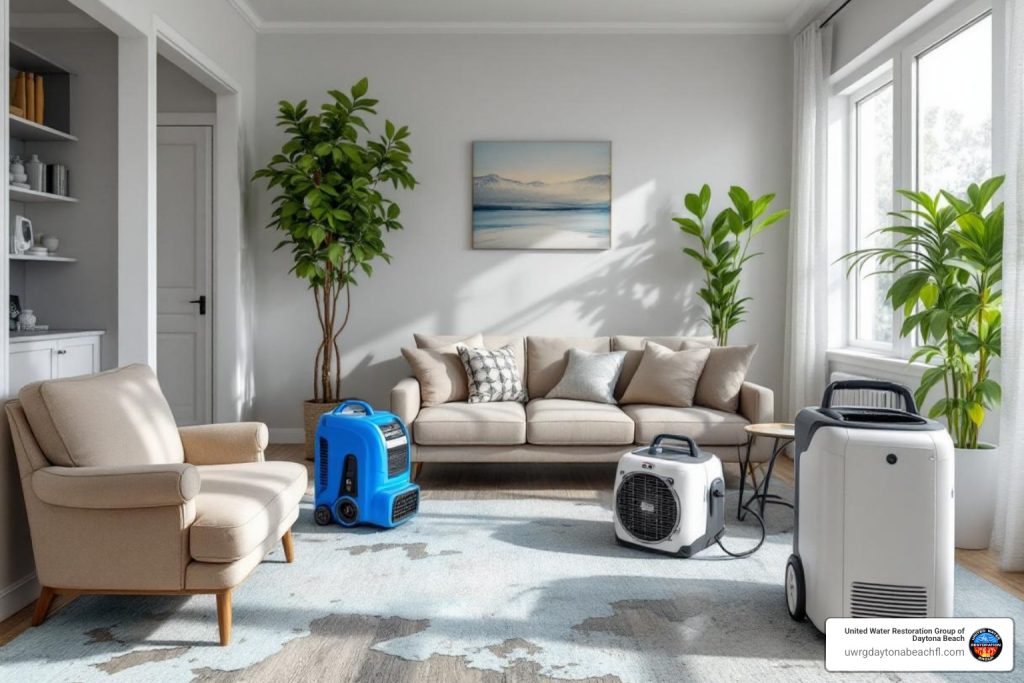
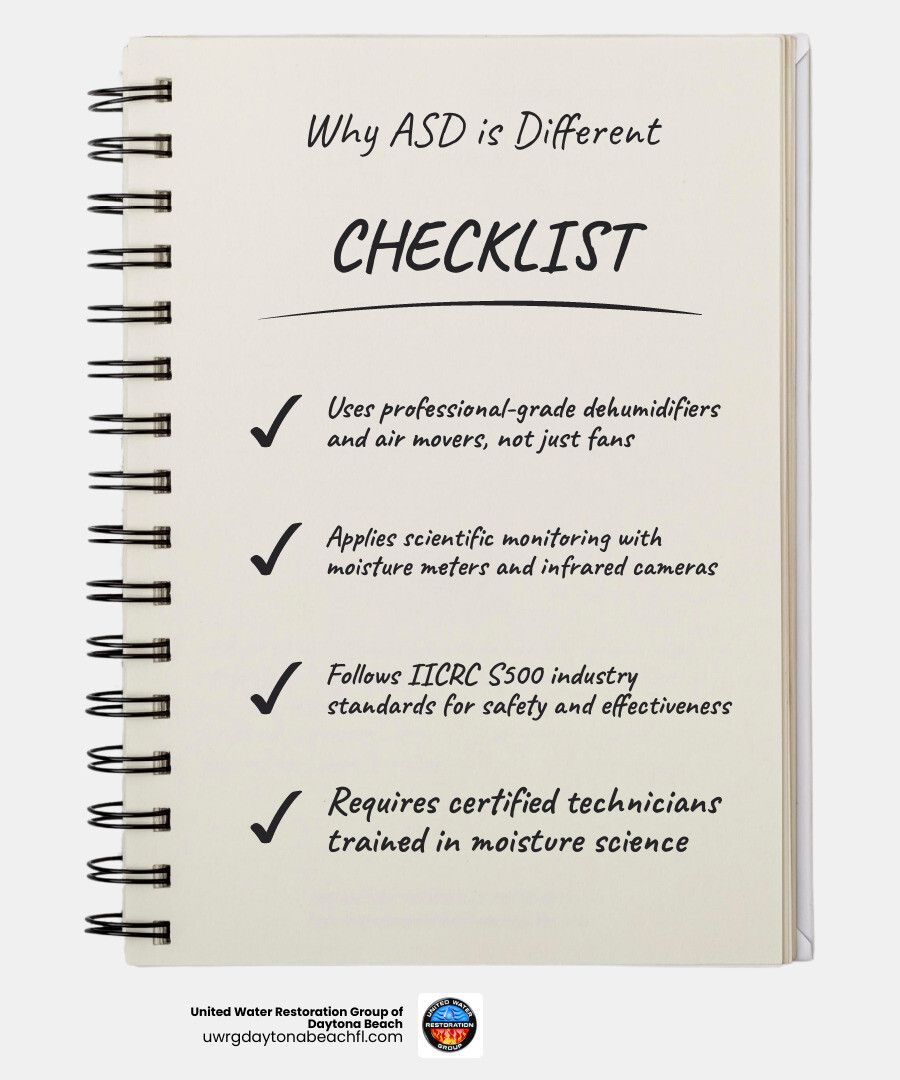
- Uses professional-grade dehumidifiers and air movers, not just fans
- Applies scientific monitoring with moisture meters and infrared cameras
- Follows IICRC S500 industry standards for safety and effectiveness
- Requires certified technicians trained in moisture science
When you find water damage in your Daytona Beach home or business, your first instinct might be to grab every fan you own and hope for the best. But water doesn’t just sit on surfaces—it migrates into walls, beneath floors, and deep into porous materials where simple airflow can’t reach it. Without the right approach, you’re not just risking incomplete drying; you’re inviting mold growth, structural weakness, and costly repairs down the line that could include 4 signs of water damage you might miss.
That’s where Applied Structural Drying (ASD) comes in. It’s not guesswork with household equipment—it’s a science-backed process that uses specialized tools, precise monitoring, and strategic environmental control to dry your property thoroughly and efficiently. ASD can dry structures containing 1,500+ gallons of water in just four days, even in challenging conditions, while preserving materials that would otherwise need demolition.
I’m Norbert Vasko, and while my background is in digital strategy and content creation, I’ve researched and worked with restoration professionals to understand how applied structural drying transforms water damage recovery from a drawn-out ordeal into a systematic, measurable process. Let me walk you through exactly how it works and why it matters for your property.
The Science of Drying: How ASD Turns a Wet Mess into a Dry Success
At its heart, Applied Structural Drying is a masterclass in environmental control, rooted deeply in the principles of physics and chemistry. It’s not about simply blowing air on wet surfaces; it’s about creating the perfect conditions for moisture to leave your building materials and evaporate into the air, where it can then be efficiently removed. This scientific approach is what allows us to save materials and reduce overall restoration time and cost.
The core principles and scientific concepts behind ASD revolve around psychrometry and vapor pressure. Psychrometry is essentially the science of drying, helping us track moisture content, drying progress, and ultimately verify project completion. It involves understanding atmospheric air mixtures, their evaluation, control, and how they affect materials and occupants. By understanding psychrometrics, our restorers can often dry and restore materials that might have been demolished in the past. To dive deeper into the fascinating world of drying science, you can explore the science of drying explained by J.S. Held.
Understanding Psychrometrics
Imagine the air around you, even on a sunny Florida day, as a sponge. This sponge can hold a certain amount of water vapor. Psychrometrics helps us understand how “full” that sponge is, and how easily it can absorb more water from your wet building materials. Key psychrometric terms we use include:
- Relative Humidity (RH): This tells us how much water vapor is in the air compared to the maximum it can hold at that temperature. A high RH means the air is already quite full and won’t absorb much more moisture from your wet walls.
- Dew Point: This is the temperature at which the air becomes saturated (100% RH) and water vapor begins to condense into liquid. If the dew point is too high, condensation can occur on cooler surfaces, leading to secondary damage or even mold growth.
- Grains Per Pound (GPP): This is a more precise measure of the actual weight of water vapor in a pound of dry air. It’s a key metric for restorers because it directly indicates the drying potential of the air, regardless of temperature.
Our professionals manipulate the environment by carefully controlling these factors. We know that warmer air can hold more moisture, but simply heating a wet area without proper dehumidification can lead to a humid, mold-friendly environment. The psychrometric chart is an invaluable tool for our technicians, allowing them to evaluate the effectiveness of drying equipment and make informed decisions based on ambient conditions.
Why Vapor Pressure is the Key to Applied Structural Drying
The real “secret sauce” of efficient drying lies in understanding and manipulating vapor pressure. Vapor pressure is the invisible force exerted by water vapor in the air. Moisture always wants to move from an area of higher vapor pressure (like a wet material) to an area of lower vapor pressure (like dry air). Think of it like a magnet pulling water out of your wet belongings.
Applied Structural Drying is all about producing an imbalanced vapor pressure between wet materials and the adjacent environment. We create a significant difference in vapor pressure so that the moisture in your wet walls, floors, and contents is literally pulled into the dry air we’ve created.
To accelerate this evaporation, we strategically heat wet materials. Increasing the temperature of wet materials provides more energy, allowing moisture to convert into vapor more readily. This, combined with constant airflow and dehumidification, creates a powerful drying force. A larger difference between the ambient temperature and the dew point temperature leads to faster and more efficient drying, ensuring your property in Daytona Beach, Palm Coast, or Jacksonville is returned to its pre-damage condition swiftly and thoroughly.
The Four Phases of the Applied Structural Drying Process
Successfully drying a water-damaged structure isn’t a one-step process; it’s a systematic, four-phase operation that our certified technicians carefully follow. These phases ensure that every drop of moisture, visible or hidden, is addressed. The IICRC has identified these four principle components for successfully drying a structure: extraction, improved airflow, dehumidification, and temperature control. Understanding these phases is key to understanding how long does the water damage restoration process take?
Phase 1: Maximum Water Extraction
Before we even think about drying the air, our absolute priority is to remove as much standing water as possible. This initial step, known as emergency water removal, is critical because removing liquid water is at least 500 times more efficient than simply relying on dehumidifiers and air movers to evaporate it.
Our technicians use powerful, professional-grade equipment for water extraction. This includes:
- Heavy-duty truck-mounted or portable extractors: For bulk water removal from floors and carpets.
- Light wands: For delicate areas or smaller puddles.
- Stationary tools (e.g., water claws): Designed to extract water from carpet and padding without removing them.
- Subsurface extraction tools: To pull water from beneath flooring materials.
By thoroughly extracting water from the start, we dramatically reduce the overall drying time and prevent further saturation of materials.
Phase 2: Strategic Air Movement
Once the bulk water is gone, the next step is to introduce strategic air movement to encourage evaporation. This is where air movers, often mistakenly called “fans,” come into play. Unlike a typical household fan that just circulates air, our professional air movers are high-velocity units designed to create rapid airflow across wet surfaces.
We use different types of air movers:
- Centrifugal air movers: These are excellent for directing airflow along walls and floors.
- Axial air movers: These create a broader, more powerful airflow, ideal for larger open spaces.
The placement of these units is crucial. Our technicians strategically position air movers—typically one for every 10-16 linear feet of wall area, angled at 15-45 degrees and almost touching the wall—to ensure continuous, rapid airflow. This constant movement displaces the moist air directly above wet surfaces with drier air, accelerating the evaporation process and promoting efficient surface drying.
Phase 3: Powerful Dehumidification
As moisture evaporates from your building materials, it enters the air, increasing the humidity. If this humid air isn’t removed, the drying process grinds to a halt, and you risk secondary damage like swelling wood, peeling paint, and, most importantly, mold growth. This is where powerful dehumidification becomes essential to prevent the hidden dangers: uncovering health risks in water, fire, and mold damage.
Our teams deploy professional-grade dehumidifiers to pull moisture directly from the air. We primarily use two types:
- Low-Grain Refrigerant (LGR) Dehumidifiers: These are highly efficient, even in cooler temperatures, and can pull moisture levels down to very low grains per pound. They are incredibly energy-efficient and effective in most residential and commercial settings, from Ormond Beach to Palm Coast.
- Desiccant Dehumidifiers: These units use a chemical drying agent (desiccant) to absorb moisture and are particularly effective in very low temperatures or when drying dense, deeply saturated materials like hardwood or concrete. They create the lowest humidity ratios, making them ideal for challenging drying environments.
By continuously removing moisture from the air, we maintain a low humidity ratio, which sustains the crucial vapor pressure differential needed for continuous, aggressive drying.
Phase 4: Precise Temperature & Progress Monitoring
Temperature plays a vital role in the drying process. Warmer air can hold more moisture, speeding up evaporation. Our goal is to maintain an optimal temperature range, typically between 70 and 90 degrees Fahrenheit, especially during the first 36 to 48 hours of drying. This controlled heat provides the energy needed to convert liquid moisture into vapor.
However, temperature control without meticulous monitoring is like driving blind. This phase involves:
- Daily Moisture Readings: Our technicians take regular readings of air, equipment, and HVAC systems.
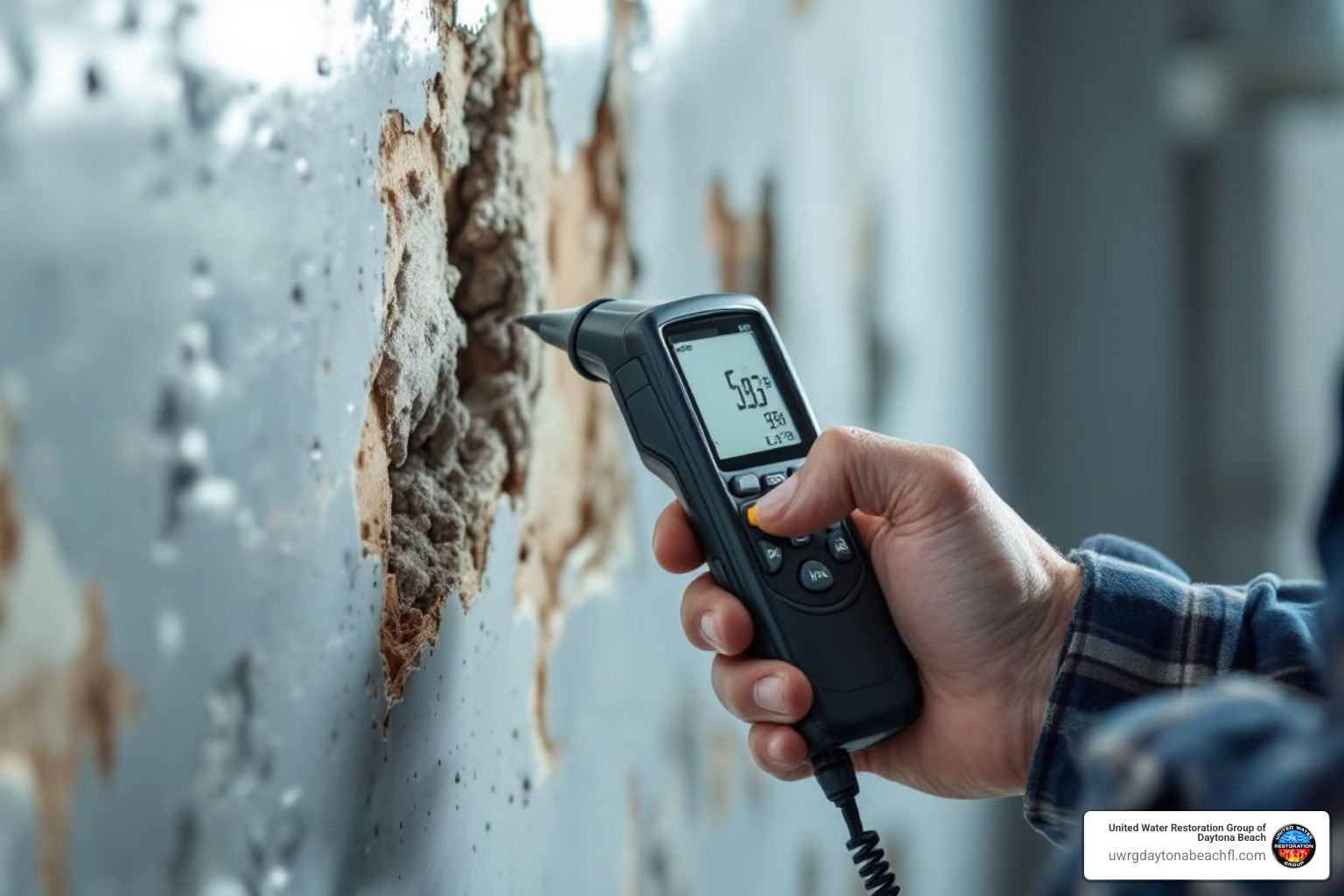
- Moisture Meters: We use specialized invasive and non-invasive moisture meters to precisely measure the moisture content of various structural materials and contents. This helps us track progress and determine exactly when materials have reached their dry standard.
- Infrared Cameras: These cameras help us identify hidden pockets of moisture behind walls or under floors that might not be visible to the naked eye.
- Documentation: Every step, every reading, and every adjustment is carefully documented. This creates a comprehensive drying record, crucial for verifying drying goals and assisting with insurance claim assistance.
This precise monitoring ensures that the drying process is efficient, effective, and complete, preventing future issues and giving you peace of mind.
Tailoring the Strategy: Not All Water Damage is the Same
Just as every property in Deland, Edgewater, or Orange City is unique, so too is every water damage scenario. There’s no one-size-fits-all solution. A successful applied structural drying strategy begins with a thorough initial inspection and detailed documentation to assess the situation accurately. We develop custom drying plans based on the specific conditions of your property and the nature of the water intrusion, all while adhering to the rigorous guidelines of the IICRC S500 Standard for Water Damage Restoration. This comprehensive standard guides our every move, ensuring best practices for all water damage remediation, including commercial water damage restoration.
Water Categories and Classes
A critical part of our assessment involves identifying the Category of Water and the Class of Water Intrusion. These classifications dictate the safety protocols, remediation techniques, and ultimately, the drying strategy we employ.
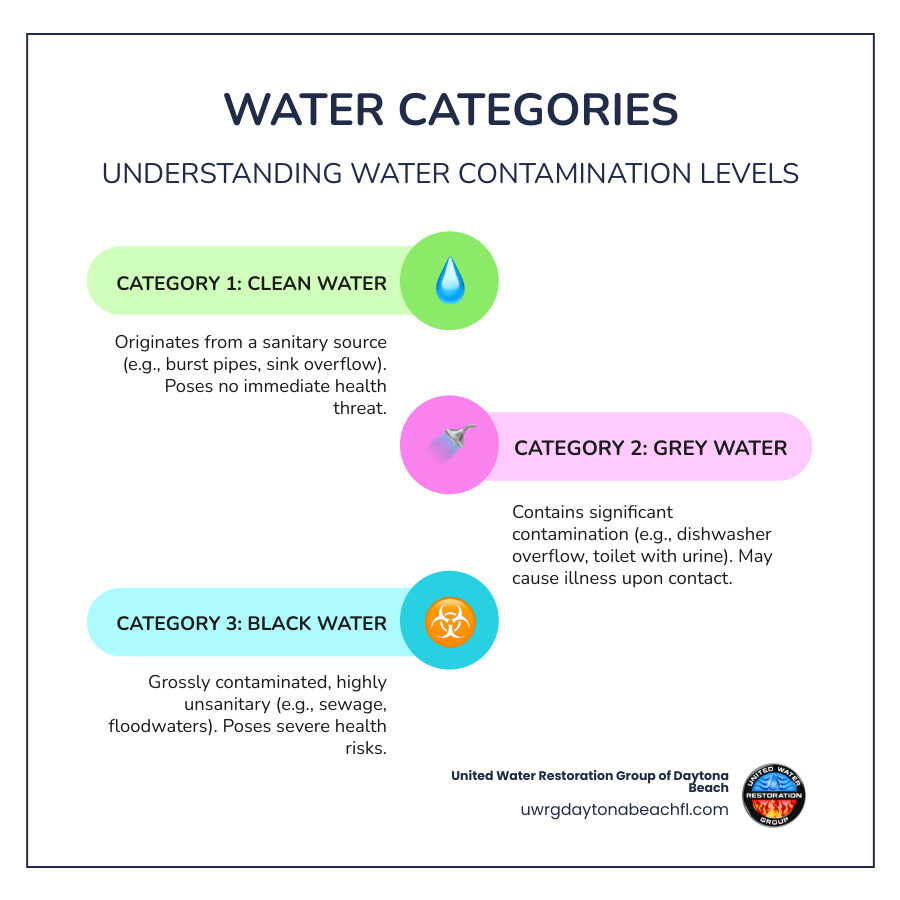
Here’s a breakdown:
| Classification | Description | Examples | Influence on Strategy |
|---|---|---|---|
| Water Categories | |||
| Category 1 (Clean Water) | Originates from a sanitary source; poses no immediate health threat. | Broken water supply lines, tub/sink overflows (without contaminants), appliance malfunctions, melting ice/snow, falling rainwater, broken toilet tanks. | Aggressive drying often possible; focus on rapid drying to prevent category escalation. |
| Category 2 (Grey Water) | Contains significant contamination; could cause sickness if ingested or exposed to. | Dishwasher/washing machine discharge, toilet overflows (with some urine but no feces), seepage due to hydrostatic pressure, broken aquariums, punctured waterbeds. | Requires careful handling; some porous materials may need removal; often necessitates disruptive drying. |
| Category 3 (Black Water) | Grossly contaminated and can contain harmful agents like sewage, pesticides, or heavy metals; poses a significant health risk. | Sewage, toilet backflows, flooding from seawater, ground surface water, rising water from rivers/streams. | Demolition of most porous materials is usually required; extensive cleaning and disinfection are critical; specialized experts may be needed. |
| Water Classes | (Based on estimated evaporation load and material types) | ||
| Class 1 | Least amount of water, absorption, and evaporation load. Only a small portion of a room is affected. | Wet porous materials represent less than ~5% of the combined floor, wall, and ceiling surface area. | Requires minimal equipment; fastest drying time. |
| Class 2 | Significant amount of water, absorption, and evaporation load. Entire room affected, moisture wicking up walls. | Wet porous materials represent ~5% to ~40% of the combined floor, wall, and ceiling surface area. | Moderate equipment needed; moderate drying time. |
| Class 3 | Greatest amount of water, absorption, and evaporation load. Ceilings, walls, insulation, and subfloor are saturated. | Wet porous materials represent more than ~40% of the combined floor, wall, and ceiling surface area. | Extensive equipment and monitoring; longer drying time. |
| Class 4 | Deeply held or bound water. Materials have very low permeability (e.g., hardwood, concrete, plaster). | Hardwood floors, concrete, plaster, multi-layer wallboard. | Requires specialized drying methods (e.g., desiccant dehumidifiers, injecti-dry systems, heat); longest drying time. |
Aggressive vs. Disruptive Drying Methods
Once we understand the water category and class, we determine the most appropriate drying method:
- Aggressive Drying (In-Place Drying): This method is typically used for Category 1 water intrusions, especially when the affected materials are salvageable and not overly saturated. It involves drying the structure and contents in place, using high volumes of equipment—air movers, dehumidifiers, and heat—to rapidly increase evaporation and pull moisture out of materials. The goal is to dry everything without removal. This approach is often possible for restoring hardwood floor water damage in certain situations.
- Disruptive Drying: This method is necessary when dealing with Category 2 or 3 water, or when materials are too heavily saturated (Class 3 or 4) to be effectively dried in place, or for materials like insulation or baseboards that are difficult to dry. Disruptive drying involves carefully removing unsalvageable or contaminated materials that cannot be dried effectively or safely. This targeted demolition creates access to hidden moisture and allows us to focus our drying efforts on the remaining structural components. While it sounds more invasive, it’s often the safest and most efficient path to complete restoration, ensuring no hidden moisture or contaminants are left behind. Our goal is always to minimize demolition wherever possible, but safety and thoroughness come first.
Why IICRC Certification and Professional Expertise Matter
When water invades your home or business, you need more than just a quick cleanup. You need certified professionals who understand the science of drying and adhere to the highest industry standards. That’s why at United Water Restoration Group of Daytona Beach, our technicians are IICRC-certified. This certification isn’t just a badge; it represents a commitment to professional standards, health and safety, and continuous training. It’s also vital for smooth navigating insurance restoration claims.
The Value of an Applied Structural Drying (ASD) Technician
The IICRC Applied Structural Drying (ASD) certification signifies advanced knowledge and skill in performing and documenting water mitigation services. This specialized training is a natural progression for water restoration technicians who have already achieved their Water Restoration Technician (WRT) certification—a prerequisite for the ASD course.
An IICRC-certified ASD technician possesses:
- Advanced Knowledge: They understand complex drying principles, including psychrometry, moisture movement, and equipment application. The ASD certification covers the effective, efficient, and timely drying of water-damaged structures and contents within a restorative drying environment.
- Hands-on Expertise: ASD courses are typically taught in-person, often in simulated flooded environments, ensuring technicians gain practical, hands-on experience.
- Commitment to Standards: They are trained to perform drying strategies while protecting the health and safety of both workers and occupants, ensuring jobs are completed according to established industry standards like the ANSI/IICRC S500.
- Career Progression: The ASD certification is a prerequisite for the prestigious Master Water Restorer designation, demonstrating a commitment to excellence in the field.
- Credibility: For restoration companies, having ASD-certified technicians proves proficiency in mitigation practices and industry standards, which is invaluable when partnering with insurance carriers and third-party administrators (TPAs). You can learn more about the specifics of the IICRC Applied Structural Drying (ASD) certification details directly from the source.
Our team members serving Daytona Beach, Deltona, Port Orange, and beyond are equipped with this expertise, ensuring your property receives the most effective and scientifically sound drying solutions.
Safety First: Protecting Occupants and Technicians
Water damage restoration, especially applied structural drying, involves inherent risks. Our priority is always the safety of both our technicians and your property’s occupants. Our IICRC-certified ASD technicians are trained to identify and mitigate these hazards:
- Electrical Hazards: Water and electricity are a dangerous mix. We carefully inspect and secure electrical systems, using ground fault circuit interrupters (GFCIs) and ensuring all equipment is properly grounded to prevent shocks.
- Slip and Fall Risks: Wet floors and equipment can create dangerous conditions. We implement clear signage, secure cables, and maintain clean work areas to minimize these risks.
- Contaminant Exposure: Depending on the water category, there can be biological or chemical contaminants. Our technicians use appropriate Personal Protective Equipment (PPE), including respirators, gloves, and protective suits, to prevent exposure.
- Containment Procedures: For Category 2 or 3 water, or when dealing with potential mold, we establish containment barriers. These physical barriers isolate the affected area, preventing the spread of contaminants and controlling airflow to direct moisture removal safely.
- Air Filtration Devices (AFDs): Also known as air scrubbers, these units are used to remove airborne particulates, dust, and potential microbial spores from the air, further protecting indoor air quality during the drying process.
Our comprehensive approach to safety ensures that while we efficiently dry your property, everyone involved remains protected.
The Bottom Line: Saving Your Structure, Time, and Money
Investing in professional Applied Structural Drying is a smart decision for any property owner facing water damage in Florida. It’s about more than just drying; it’s about comprehensive restoration and protection.
Here’s how ASD contributes significantly to your peace of mind and your bottom line:
- Minimizing Demolition and Repair Costs: By precisely controlling the drying environment, we can often save structural materials and contents that would otherwise be deemed unsalvageable. This means less tearing out, fewer materials to replace, and a significant reduction in overall repair costs.
- Faster Recovery and Reduced Downtime: Our scientific approach accelerates the drying process. While 1,500+ gallons of water can be dried in just four days, this efficiency means you can get back into your home or reopen your business faster, minimizing inconvenience and business interruption.
- Preventing Further Damage and Mold Growth: Incomplete drying is a breeding ground for mold. By thoroughly drying materials to their pre-loss condition, we prevent secondary damage like warping, odors, and harmful mold growth, protecting your property value and your health. Drying surfaces below 0.75 water activity can effectively halt microbial growth, even if the core material is still slightly damp.
- Protecting Property Value: A property that has undergone professional structural drying is less likely to suffer from long-term issues associated with water damage, preserving its structural integrity and market value.
At United Water Restoration Group of Daytona Beach, we understand the urgency and stress that water damage brings. Our IICRC-certified technicians are available for 24/7 emergency restoration services across Daytona Beach, Ormond Beach, Bunnell, Debary, Deland, Deltona, Edgewater, New Smyrna Beach, Orange City, Palm Coast, Port Orange, and Jacksonville. We combine cutting-edge technology with expert knowledge to deliver fast, reliable, and comprehensive restoration.
Don’t let water damage turn into a bigger problem. When disaster strikes, just drying isn’t enough—you need to ASD it. Contact us for professional water damage restoration and let our experts restore your property with the smart, scientific approach of Applied Structural Drying.